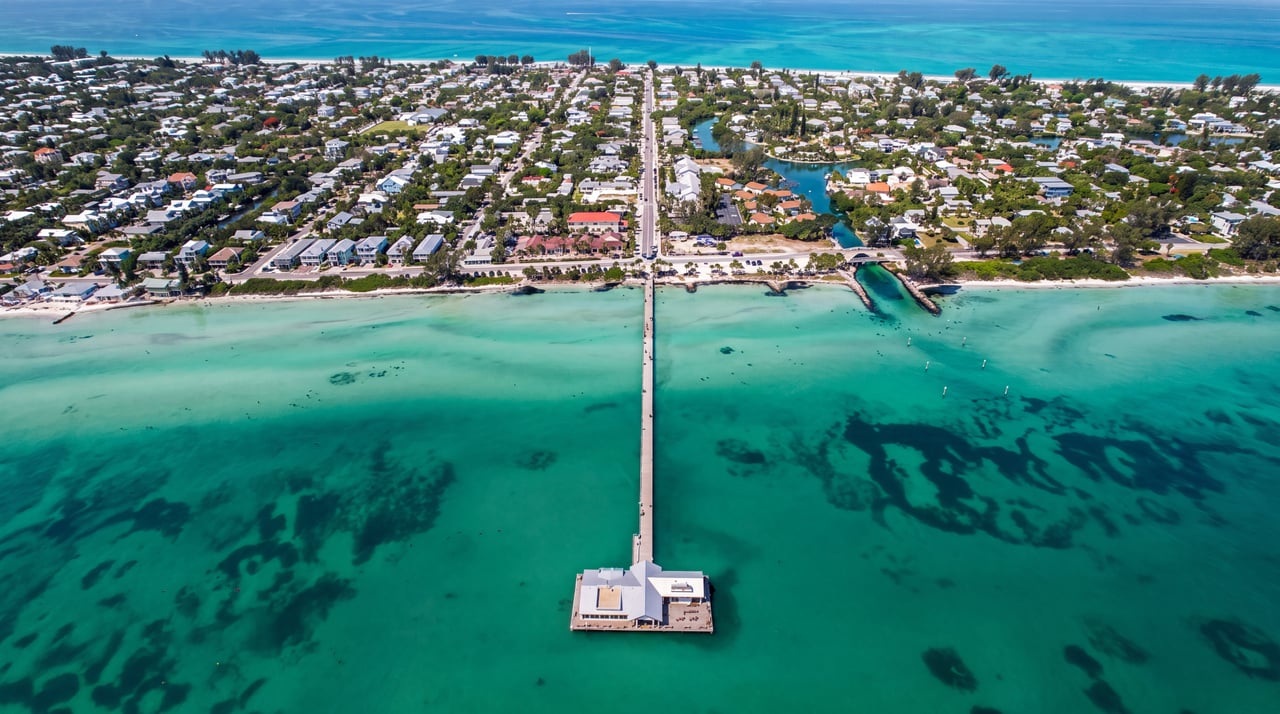
Walk to the end of Pine Avenue right now and you will see poles. Rows of them, sticking up out of Tampa Bay in straight lines, with gulls resting on top and the old T-end building still standing behind them looking a little stunned. If you have lived here a while, you already know what this means. If you are newer to the island, here is the short version: Hurricane Milton split the Anna Maria City Pier in half in October 2024, and the walkway that used to carry you out over the bay has been gone for almost two years.
Everyone on this end of the island has heard some version of "the pier is coming back this fall." The Facebook groups have been saying it since spring. The problem is that version of the story stops at the headline. It does not explain why this rebuild, which followed a worse storm than the last one, is on pace to finish faster than the last one did. Once you see the funding behind it, the timeline stops feeling like luck and starts looking like the point.
This Is Not the First Time, and That Is the Point
The pier that locals picture when they say "the pier" is not the original. The first version went up in 1911, built by the Anna Maria Beach Company to bring day-trippers over by steamboat from Tampa and St. Petersburg. Since then it has gone down and come back in 1921, 1935, 1974, 1988, and again in 2017 after Hurricane Irma tore through it. The city rebuilt it after Irma and reopened it in June 2020, only to watch Hurricanes Helene and Milton wreck it again four years later. This is the sixth rebuild.
That history matters because it tells you the pier has never really been a fixed structure. It is more like a position the city keeps defending. Mayor Mark Short put it plainly to WWSB this spring, calling it the number one tourist destination in Manatee County and the kind of place people specifically drive to see. The city is not rebuilding a nostalgic landmark this time so much as trying to build one that survives the next storm, which is a different engineering problem than the one it solved in 2020.
What's Actually Different This Time
The old wooden walkway is gone for good. According to Public Works Manager Dean Jones, the new pilings are being driven to the hard pan roughly 40 feet below the deck, with concrete slabs, some 800 feet of them, tied to the piling bents with rebar and steel spikes. Holmes Beach City Commissioner Carol Whitmore, describing the same work, said crews have gone significantly deeper than the pilings used after Irma. Whether the exact number is 40 feet or 50, the intent is the same: this version is not meant to be swept out by the next major hurricane the way Helene and Milton did to the last one.
That is the kind of milestone that is easy to miss unless you are watching the water line at the end of Pine Avenue change week to week. The poles you see today are not placeholders. Each one is already doing the structural job it was designed for, which is standing through the next storm instead of becoming debris in it.
Why the Money Is the Real Story
Here is the part that explains the schedule. The rebuild is priced at close to $8 million, and FEMA is covering nearly half of it. Manatee County is putting in $2 million from tourist development tax revenue, and the state kicked in another $1.2 million on top of that, with the city responsible for the remainder. Three separate government bodies have their names attached to this project, and each of them has its own reporting requirements tied to the money they contributed.
Compare that to what happened after Irma. That storm hit in September 2017, and the pier did not reopen until June 2020, nearly three years later, on a single insurance and municipal timeline with none of the outside pressure this rebuild has. This time, the damage was arguably worse, the pier was split in two by Milton and the walkway was gone entirely, yet the city is targeting a finish inside two years. FEMA, the county, and the state all have their own reporting obligations tied to the dollars they put in, and that is not a small thing for a small city government working through a project this size. Money with strings attached moves faster than money that answers to no one but the people spending it.
What Comes Back at the End of the Walkway
The building at the T-end survived the storm even though the walkway leading to it did not, and it is getting a familiar face in a new form. Brian Seymour, who ran the original restaurant on the pier before the storm and who also owns the Anna Maria General Store on Pine Avenue, is opening a new restaurant called PIERadise in that space. He has described it as an upgrade from what was there before, which he called an upgraded snack shack with no real indoor cover from the weather.
This time there will be an enclosed dining option, not just a counter open to whatever the Gulf throws at it. It is a small detail, but it tells you something about what the city and its tenants learned from the last version. The pier is not just being put back the way it was. It is being put back the way it should have been built the first time.
What Locals Have Actually Lost While Waiting
Ask around at the businesses closest to the water and the closure has a shape you can feel, not just read about. Taylor DeLuca, who manages Two Scoops Ice Cream near the pier, described three feet of water moving through the shop during the storm and said the loss of pier foot traffic has been noticeable ever since. Morgan Bryant, who owns Cool Beans A.M.I., called the pier the heartbeat of the community and said the empty space at the end of Pine Avenue has been a daily reminder of what is missing, not just for visitors but for the people who work there.
"For two years, we looked out at this empty space that used to be filled with people all the time," Bryant said. "It's just going to be really exciting when it reopens again."
That is not marketing language. That is someone who watches the same view every day describing what changed when the crowds stopped coming through.
What This Fall Actually Looks Like
The city's own target is to finish construction in October, and multiple officials have described a fall 2026 reopening, though some coverage has pointed toward a slip into November. Nobody involved is treating that as a locked date. The T-end building still needs repairs the city has not fully scoped, and weather this time of year can move a schedule by weeks without much warning. What is different from past rebuilds is that the milestones so far, pilings driven, slabs poured, a signed lease with a signed tenant, have actually been hit on the timeline the city set for itself.
If you want a pier walk before the City Pier reopens, Bridge Street Pier down in Bradenton Beach has been running the whole time and remains the reliable option for an evening walk or a line in the water. It is not the same pier, and nobody on this island would tell you it is, but it is open tonight if you want one.
The next real milestone to watch for is not another quote from a commission meeting. It is the walkway itself connecting all the way to the T-end building, which is the point where a reopening date stops being a target and starts being a fact.
For more on what is actually happening around Anna Maria Island, from pier updates to what is opening on Pine Avenue, Your AMI Home Girls tracks the island the way people who live here do. If you are thinking about a move to this end of the Gulf Coast, reach out any time for a conversation about what life here actually looks like, pier included.