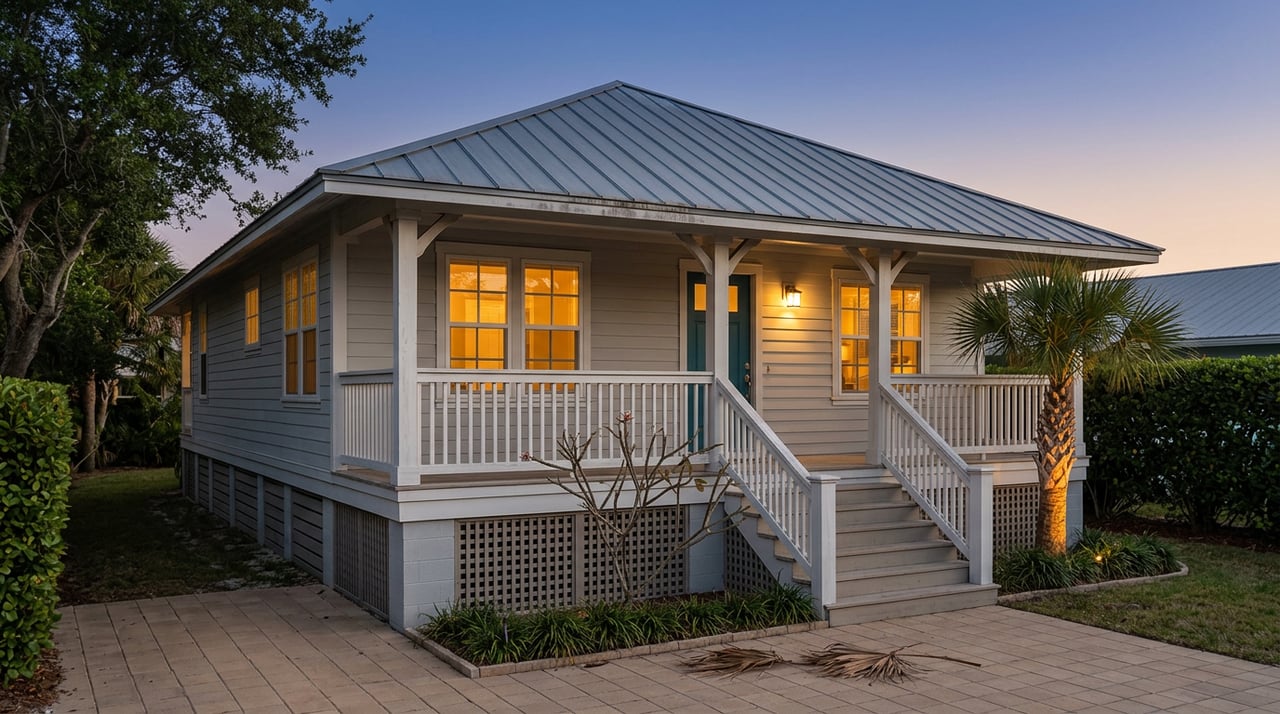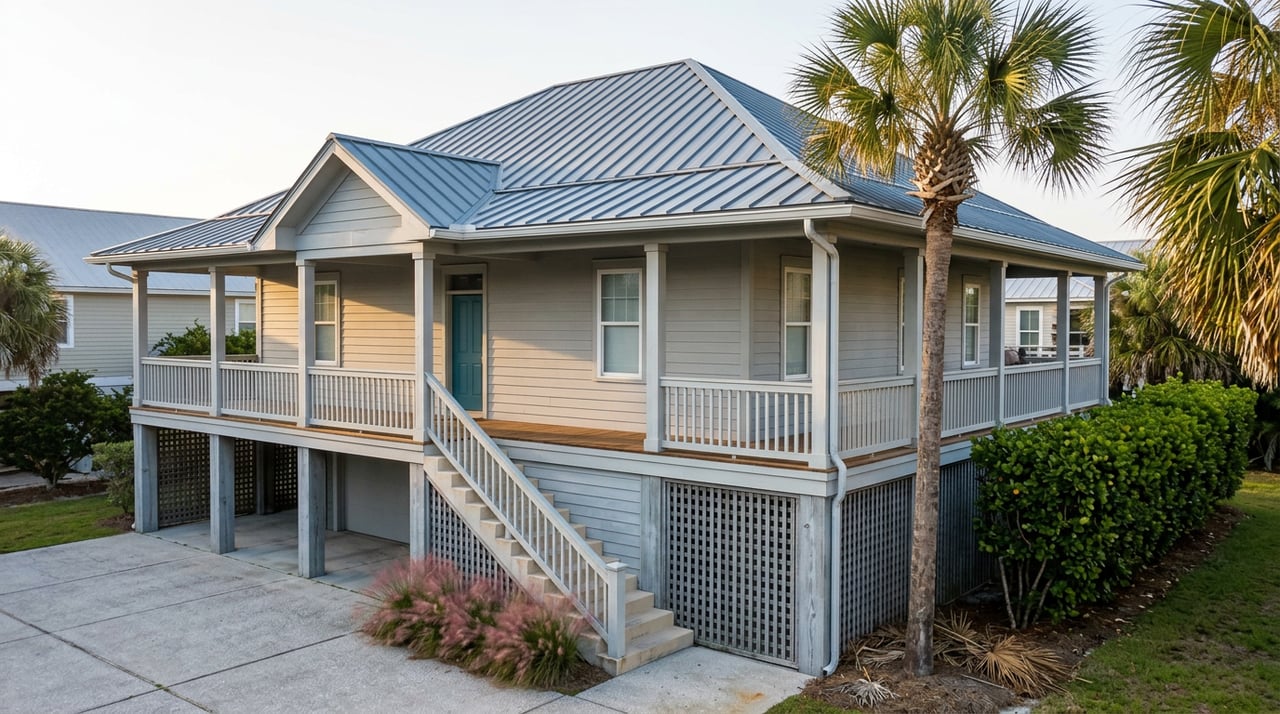
Walk two lots on the same Anna Maria block, one twice the size of the other, and most buyers assume the math is simple: more land, more house. On this island, that assumption is wrong, and the reason has nothing to do with the number everyone checks first.
Ask any longtime AMI buyer what caps house size in the City of Anna Maria and you'll hear the same answer: the 37-foot height limit, measured from the crown of the road. It's the number on every builder's spec sheet and every listing agent's talking point. It's also not the rule doing the real work. The number that actually decides how much livable house you get is a lot-size formula most buyers never ask about until they're deep into a building permit, and it behaves in a way that runs counter to how land value usually works.
The Ceiling Everyone Assumes, and Why It's Been There So Long
Anna Maria's skyline has looked essentially the same for half a century. The only high-rises on the island, Martinique North and Martinique South, were built in 1973 and are grandfathered in under codes that no longer allow anything like them. Every other structure on the island tops out well below that scale, which is part of why the city still reads as a collection of cottages rather than a resort strip.
Height feels like the obvious explanation for that. It isn't the whole story. The height limit tells you how tall a house can be. It says nothing about how much living space you're allowed to put inside that envelope, and that second number is where the real constraint lives.
The Rule That Actually Does the Work
Anna Maria's zoning code caps the air-conditioned living area of a house through what the city calls a living area ratio, or LAR. Under the current code, a lot up to 15,000 square feet gets a 40 percent ratio. Land between 15,001 and 21,000 square feet only earns 35 percent on that additional portion. Anything above 21,000 square feet drops to 30 percent on the excess.
Run the numbers and the pattern becomes clear:
| Lot size | Ratio applied | Maximum living area |
|---|---|---|
| 15,000 sq ft | 40% | 6,000 sq ft |
| 21,000 sq ft | 40% on first 15,000, 35% on the next 6,000 | 8,100 sq ft |
| 30,000 sq ft | 40% / 35% / 30% blended across tiers | 10,800 sq ft |
Double your lot from 15,000 to 30,000 square feet and your allowable living area doesn't double. It grows from 6,000 to 10,800 square feet, an increase of 80 percent on twice the land. Buy more dirt in Anna Maria and you're paying for the dirt itself, not for a proportional expansion of the house that sits on it.
A lot twice the size doesn't buy a house twice the size in Anna Maria. It buys you land.
This same mechanism works at the small end too. A typical 5,000-square-foot in-town lot caps out at 2,000 square feet of air-conditioned space, a figure attorneys who track the ordinance have used as their standard illustration for years. That's a real number for a real, common lot size on this island, not a hypothetical.
Why Taller Often Means Less Upstairs
The living area ratio has a second layer that trips up even careful buyers. Of whatever living area a lot is allowed, only a portion can go on the second floor. For structures 27 feet or shorter, up to half the allowed living area can be built upstairs. For anything taller, the cap drops to one third.
Here's the part that seems backwards until you think it through: most new construction on the island builds close to the 37-foot ceiling, because that height gets a house the flood-elevation freeboard insurers and lenders want to see. Building tall, in other words, is often the safer, more insurable choice. But building tall also triggers the stricter one-third rule on the second floor.
Take that same 2,000-square-foot cap on a 5,000-square-foot lot. A shorter home could put up to 1,000 square feet upstairs. A taller home, the kind more owners are choosing for insurance and elevation reasons, is limited to roughly 667 square feet upstairs, pushing the rest of the square footage onto the ground floor footprint. That ground floor is itself boxed in by a separate 40 percent maximum on impervious surface and building coverage, plus a minimum open space requirement. The house that seems safer to build ends up with less room to stretch upstairs and less slack downstairs.
Three Cities, Three Different Ceilings
Anna Maria is one of three municipalities on the same seven-mile barrier island, and each one runs its own numbers. Height limits alone tell you that much: Anna Maria allows 37 feet, Holmes Beach allows 36 feet, and Bradenton Beach allows 29 feet. Each city also pairs its height rule with its own version of lot coverage and living area math, which means a buyer comparing a lot in Anna Maria against a similarly priced lot in Holmes Beach or Bradenton Beach isn't just comparing sale prices. They're comparing three different formulas for how land converts into house, and the formula matters as much as the price tag.
That's worth sitting with if you're cross-shopping the island. The listing price per square foot tells you what a buyer paid for what got built. It tells you nothing about what a different buyer, on a different lot, in a different city on the same island, would be allowed to build next.
The Ceiling Isn't Even Settled
None of this is static history either. In June 2024, Anna Maria's city commission approved Ordinance No. 24-927, sending a height-limitation charter question to voters at the November 5, 2024 general election. Height and bulk limits in this city aren't just a staff-level zoning decision buried in a code book. They're treated as significant enough to put directly in front of residents at the ballot box.
Whatever the outcome of that particular vote, the fact that it went to referendum at all tells a buyer something a listing sheet never will. The ceiling on what you can build in Anna Maria is not a fixed fact you inherit when you close. It's an ongoing conversation between residents protecting the island's low-rise character and owners who want more room, and it can move.
What This Looks Like at Today's Prices
As of mid-September 2026, active MLS listings show 66 single-family homes for sale in Anna Maria, at a median list price of roughly $2,985,000, about $1,352 per square foot for a typical 2,238-square-foot home, with listings sitting a median of 146 days on the market. Run the standard math on that median price, a 20 percent down payment near $597,000, financing the balance around a 6.76 percent 30-year rate, and principal and interest alone lands near $15,500 a month. Add Manatee County's typical millage rate against a reset assessed value after the homestead exemption, plus a county-average insurance premium, and total carrying costs on that median home run close to $19,900 a month before any HOA or CDD assessment.
Here's where the living area ratio changes how you should read that price. Because square footage doesn't scale with lot size the way it does in most markets, a chunk of what that median price is buying isn't extra livable space. It's land, location, and the option value of a lot that could someday support more house if the code changes. That helps explain why bigger, pricier parcels can sit on the market longer than smaller ones. Buyers are pricing land and view against a house size that the code, not the lot, ultimately decides.
A Few Questions Worth Asking Before You Fall for a Lot
Does the living area ratio count garages, porches, or pools? Air-conditioned living space is what the ratio measures. Pools and hot tubs permitted after January 1, 2016 count toward the separate impervious surface limit, not the living area ratio itself, which is a distinction worth confirming with your builder before you assume a pool "costs" you house size.
Can an older home lose its grandfathered status if I renovate? Substantial renovations or additions typically trigger current code compliance, which is exactly why a home that looks oversized for its lot today may not be replicable if it burns down or gets rebuilt. That gap between what exists and what's currently allowed is worth pricing into any offer on an older, larger cottage.
If I want more house, should I just buy more land? Not automatically. As the math above shows, land beyond roughly 21,000 square feet returns less living area per dollar than land under that threshold. A smaller lot at the top of the 40 percent tier can sometimes be a more efficient buy than a larger one that spills into the 35 or 30 percent brackets.
If you're comparing lots across Anna Maria, Holmes Beach, and Bradenton Beach and want someone to run the actual buildable numbers before you fall for a price per square foot, that's exactly the kind of homework Your AMI Home Girls does before you ever make an offer. Get your free home valuation or schedule a consultation, and we'll walk the lot math with you before the code does it for you.