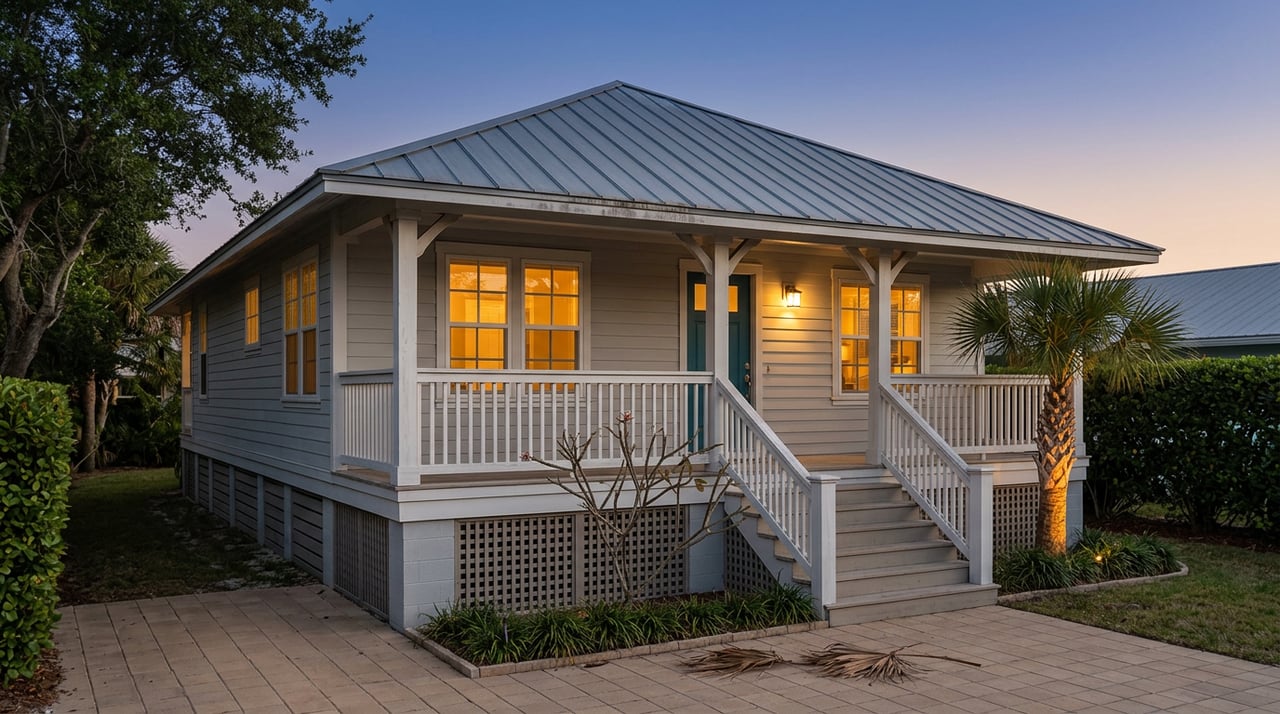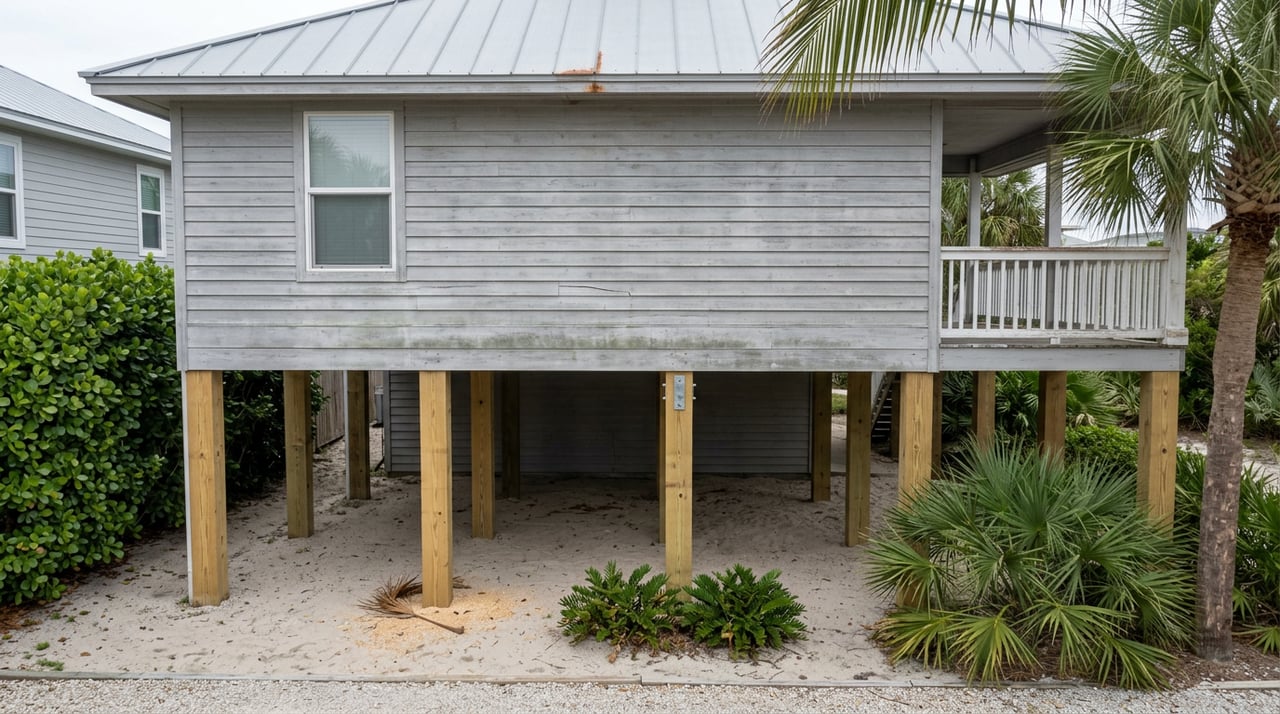
Drive down Gulf Drive in Holmes Beach right now and you will pass storm-damaged cottages sitting a few doors apart with two completely different futures. One is being jacked up onto new pilings and turned into a compliant, insurable home. The other already has a demolition conversation underway with the city. From the sidewalk, both look like they could go either way. They cannot.
At 2416 Gulf Drive, a blue stilt home has been flagged for demolition. City staff described it to commissioners in February as severely deteriorated and potentially hazardous, and the city is now working with the owner on next steps, including temporary fencing while plans for a future home move through the Florida Department of Environmental Protection. A short drive away at 1203 Gulf Drive South, an orange bungalow is headed the same direction after its owner applied for help through the state's home-elevation grant program and was turned down because the structure failed inspection.
If you have been scrolling Holmes Beach listings, you have almost certainly seen both kinds of homes without knowing which bucket they are in. The listing language sounds nearly identical from one to the next: renovate or rebuild, solid foundation, bring your vision to life. One of those "potential" houses can actually be lifted, rewired, and reopened. The other cannot be lifted at all, regardless of what the buyer is willing to spend.
The assumption most buyers bring to a fixer
The natural read on an older, storm-affected Holmes Beach home is that the outcome comes down to money. Enough budget, enough patience, and any house can be brought back. That assumption holds for cosmetic damage. It falls apart once a home crosses into what federal flood rules call substantial damage or substantial improvement, the threshold under the National Flood Insurance Program that applies once repair or renovation costs reach half the structure's market value. Cross that line and the entire structure, not just the damaged part, has to meet current flood code, which usually means elevation.
That part of the rule is national and has been written into flood ordinances across the country for years. What is easy to miss is the second filter sitting underneath it in Holmes Beach, one that has nothing to do with financing.
The variable your budget cannot fix
According to the city's building official, Rob Perry, older wood-frame structures, generally those more than about fifty years old, often cannot physically survive the lifting process itself. The framing simply is not built for it. That is a structural fact about the house, not a statement about the owner's finances or intent, and it is the reason the bungalow at 1203 Gulf Drive South was denied Elevate Florida funding after it failed inspection. The state's own mitigation program, run through the Florida Division of Emergency Management, exists to pay for exactly this kind of elevation work, and this house still could not qualify.
That single fact reframes what a "renovate or rebuild" listing actually means in Holmes Beach. It is not an open question waiting on the buyer's checkbook. In many cases the house itself has already decided, and the listing language just has not caught up yet.
Reading a Holmes Beach fixer listing
| Renovation and Elevation Path | Teardown and Rebuild Path | |
|---|---|---|
| Typical structure profile | Newer or well-maintained builds that can withstand lifting | Many older wood-frame cottages built before the 1970s |
| Elevate Florida outcome | Passes inspection, structure lifted intact onto new pilings | Denied after failing inspection, as at 1203 Gulf Drive South |
| Current code requirement | Must meet Ordinance 23-01: base flood elevation plus 3 feet of freeboard, no stem wall construction | Same requirement applies, but only achievable through a new build |
| What happens next | Home reopens as an insurable, code-compliant property | City works with the owner toward demolition and new construction on the same lot |
The ordinance in that second row is not a minor detail. Holmes Beach raised its elevation standard to base flood elevation plus three feet for all new structures back in 2023, and eliminated the older stem wall construction method entirely. Any home going through either path today is being built or rebuilt to that higher bar, which is part of why a freshly elevated cottage and a brand new build can end up looking and pricing similarly once the work is done.
Why the city just rewrote its own math
The line between renovation and full compliance is thin enough that Holmes Beach changed how it enforces it. Through the end of 2024, homeowners who had renovated up to just under the 50 percent threshold had to wait a full year after their final inspection before doing any additional work, even if unrelated storm damage hit the house in that window. Building Official Neal Schwartz said some homeowners ended up "caught between a rock and hard place," sitting idle for a year on projects that were not even finished. The city eliminated that one-year lookback in December 2024.
The fix was not without a catch. Building Official Neal Schwartz has been clear that the city still will not tolerate phasing, splitting one project across multiple permits to dodge the 50 percent threshold. FEMA takes a dim view of that approach, and Holmes Beach has reason to care: the city's flood plain rating currently earns every property owner in Holmes Beach a 20 percent discount on National Flood Insurance Program premiums. That discount is community-wide, so the city's caution about who qualifies for what protects a benefit that has nothing to do with any single house.
What the current numbers are actually showing
As of the city's February 2026 update to commissioners, 19 new homes were under construction in Holmes Beach, with permit applications expected on another 19 vacant lots. That is close to 40 properties moving through some stage of the rebuild-or-replace pipeline at once, on top of whatever inventory is still working through renovation or demolition decisions individually.
That pipeline shows up in how long homes are sitting on the market. In April 2026, the median sale price for a Holmes Beach home was $1,395,000, and homes were taking an average of 107 days to sell, compared with 65 days a year earlier. Slower does not necessarily mean softer demand here. It is consistent with buyers doing more diligence before writing an offer on a market where two houses that look alike on paper can have completely different paths in front of them.
The state-level program buyers are counting on is not moving quickly either. As of July 2026, FEMA had approved just over 50 Elevate Florida elevation projects statewide and released nearly $24 million in funding, while homeowners across the Gulf Coast were still waiting on approvals more than a year after applying. A structurally eligible house is not automatically a quickly elevated house. The queue itself is part of the cost of buying into a fixer here.
What this means if you are comparing listings
Before you fall in love with a Gulf Drive cottage priced like a bargain, ask two questions that go beyond curb appeal. First, does the city have a substantial damage determination or an elevation certificate on file for that address? Holmes Beach's building department maintains records and will send electronic copies free of charge. Second, has the owner already applied to Elevate Florida, and if so, what was the outcome? A denial tied to structural age, like the one at 1203 Gulf Drive South, tells you more about the house's actual future than any listing description will.
None of this means older Holmes Beach homes are bad buys. Plenty of them are exactly the right project for the right buyer. It means the renovation-versus-rebuild decision is often already made before the house ever hits the market, and knowing which path a specific property is on changes how you should think about timeline, financing, and what you are really paying for.
A few questions worth asking directly
Does a home need to have flooded to apply for Elevate Florida? No. The property does not need to have experienced flooding or damage to be considered, though applications may be prioritized based on a documented history of loss.
Where do I check if a Holmes Beach address already has an elevation certificate on file? The city's building department keeps a searchable record and provides electronic copies at no charge, which is worth doing before you write an offer on anything built before the 1970s.
If a neighboring lot gets demolished instead of renovated, does that affect my own flood insurance? Not directly. The city's flood rating and the 20 percent NFIP discount it provides apply community-wide, which is exactly why Holmes Beach polices phasing and substantial improvement calculations as closely as it does.
If you are trying to figure out which side of this line a specific Holmes Beach property sits on, that is the kind of question worth asking before you fall for the listing photos. Your AMI Home Girls can help you pull the history on a specific address and talk through what a renovation or rebuild timeline would actually look like. Get your free home valuation or schedule a consultation whenever you are ready to talk specifics.